Your Nutella biscuits will never be like mine...
Neither if you get my recipe MUAHAHAH
If you ever cooked you're friends something your family has been making generation after generation
or following a recipe written by yourself and they asked you the recipe,
in that moment you may have desired to put on it a sort of control system to grant the authorization,
fidelty and quality of future replicas. (The title deals with the yogurt-pastry-Nutella biscuits my mum
excellently cooked when I was a child for my bithdays, which
now are my strong point at friends parties - despite being the recipe so simple, no ones ever managed to make a decent reproduction of them).
Switch the cake or whatever it is with a software and you'll see what a software license is for: a
typical software license grants the licensee (typically an end-user) the permission to use one or more
copies of a software.
Isn't this copyright??
Not properly:
Copyright is the legal term used to declare and prove who owns the intellectual property (the code, text, etc.).
Licensing is the legal term used to describe the terms under which people are allowed to use the copyrighted material.
Kind of licenses
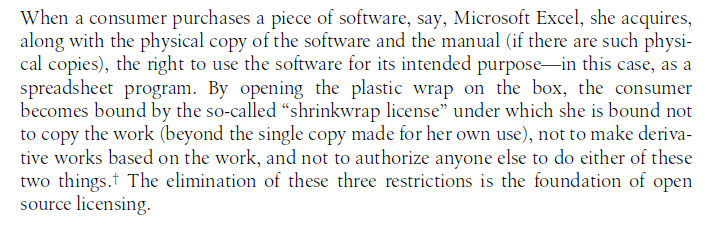
Cleared up this point, we must make a distinction in types of licenses: proprietary software and
free and open source software (FOSS).
Proprietary software
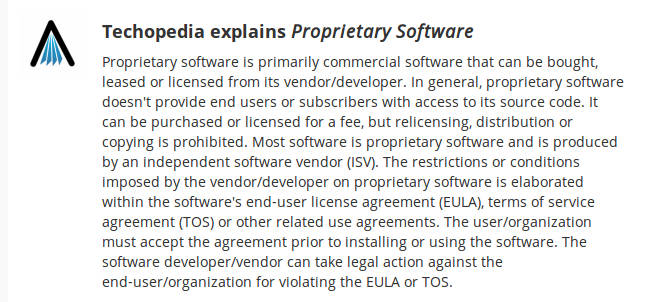
Proprietary
software typically keeps the source code hidden ("closed source"). On Techopedia
I found this brief useful explanation:
FOSS software licenses the right to modify and re-use a software product to the customer and therefore the software is given together with the modifiable source code ("open-source"). Let's now distinguish between free and open source:
Free software
Even tough it may be intended as "no payment required", free instead means that everyone can use, copy, study, modify, re-distribute and re-sell the software. To better understand this, let's list the four freedoms principles:
- Freedom 0: The freedom to run the program for any purpose.
- Freedom 1: The freedom to study how the program works, and change it to make it do what you wish.
- Freedom 2: The freedom to redistribute and make copies so you can help your neighbor.
- Freedom 3: The freedom to improve the program, and release your improvements (and modified versions in general) to the public, so that the whole community benefits.
It's important to notice that for the first and third freedom, it's required a free access to the source code of the software.
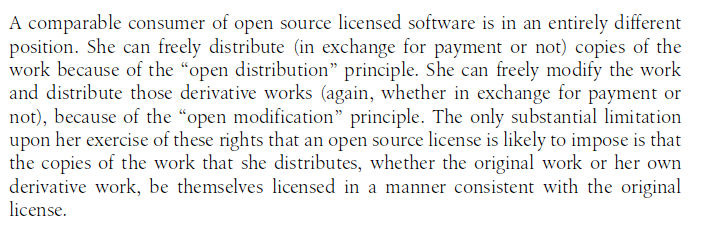
Open source software
very very similar to the previous, this kind of license still requires free access to the
source code but can put stricter limits to the user freedoms:"an open source license
may require that derivative works be distributed on the same terms under which
the licensee was permitted access to the work
under the original license.
This means that those people who receive copies of these
works must themselves be able to redistribute the original and to make derivative
works from the original, subject only to the limitation that they allow others to do
the same. This principle is called “generational limitation”.
This limitation may,
depending on the terms of the original license, prevent open source code from “going
closed” and require that users and contributors to the code abide by the communi-
tarian values of open source." from page 6 of Understanding Open Source and
Free Software Licensing by Andrew M. St. Laurent.
The most known licenses
Creative Commons
I already knew CC license because even before starting Fab Academy 2017
(which is in my life the first experience where I invented and
created something new - and more relevant that parfumed water
(watercolours + parfum + water) that I used to make bottles of when I was 5),
I asked my self how the material that already 7 years of hundreds students gave birth to was protected
and distributed and I really got interested in CC which, to me, has a strong and reasonable principle
at the basis of its rules:
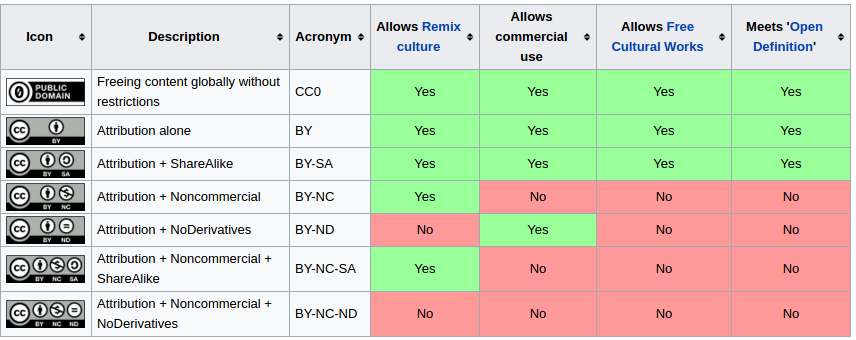
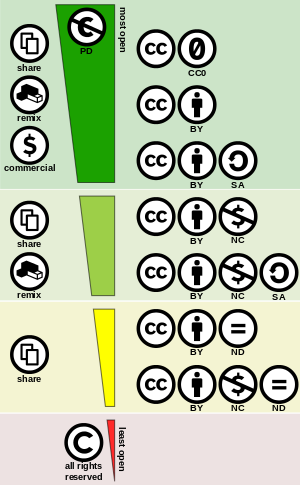
 There are six different types of CC license which are briefly summarized in this table I found on Wikipedia:
GNU General Public License
Being a free software license GPL guarantees end users the freedom
to modify the work, as well as to copy and redistribute the work or any derivative version.
The licensee is allowed to charge a fee for this service, or do this free of charge. This latter
point distinguishes the GPL from software licenses that prohibit commercial redistribution.
The Free Software Foundation (FSF) argues that free software should not place restrictions
on commercial use and the GPL explicitly states that GPL works may be sold at any price.
A point that the GPL additionally states (and that's worth underline to me) is that a distributor may not impose
further restrictions on the rights granted by the GPL. It may look obvious but it already distinguish a bit GPL from CC,
which looks more flexible in end user's decision about redistributing his work. So with GPL activities such as distributing
of the software under a non-disclosure agreement or contract are forbidden.
CURIOSITY: GPL is Linux kernel's and GCC (GNU Compiler Collection)'s license.
MIT
MIT License derives its name from Massachusetts Institute of Technology
and it is compatible with many copyleft licenses. It is very similar to GNU GPL License so that MIT licensed
software can be integrated into GPL software, but not the other way around.
This license provides great freedom as the License terms declare:
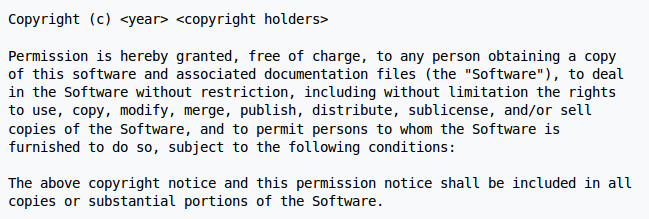 Also, another scheme I found really useful to clarify ideas about CC position among public domain-all right reserved range is teh following:
On Wikipedia I found an interesting and well made sheme that compares many licenses' characteristics. I below report the rows that refer to the licenses I talked about:




My choice
Owing to sharing and contributing flexibility of CC licensed project, I decided I wanted to leave by now the window of commercial
selling open to my project, since I would like to further develop it and maybe share it with people who are interested in and may want
to put themselves into it. I firmly believe sharing and freedom are two foundamentals words for the future of projects development but
on the other hand I also recognized that no-limits permissions may lead to abuses or unfitting use of rights granted.
I therefore decided to use CC-BY license which allows licensees to "copy, distribute, display and perform the work and make derivative
works and remixes based on it only if they give the author or licensor the credits (attribution) in the manner specified by these".