Fabacademy 2017
Fifth Week
Fifth task
3D Printing and scanning
This week's task was to start 3D printing and scanning and by doing so develop designs that take advantage of the unique characteristics of additive manufacturing. In additive manufactured objects, designers have great control on not only the boundary of the object but the structure of the 3D printed object itself. This opens up an unprecedented flexibility to transform the object’s strength-to-weight ratio or the position of the object’s center of mass for example.
I would like to explore the possibilities of additive manufacturing for certain components of my window project.
Metamaterials mechanisms
On my research on functional additive manufacturing mechanism I found This paper by a group of researchers –Alexandra Ion, Johannes Frohnhofen, Ludwig Wall, Robert Kovacs, Mirela Alistar, Jack Lindsay, Pedro Lopes, Hsiang-Ting Chen, and Patrick Baudisch– of the Hasso Plattner Institute in Germany about Metamaterials mechanisms.
Metamarials are artificial structures with mechanical properties that are defined by their usually repetitive cell patterns, rather than the material they are made of.
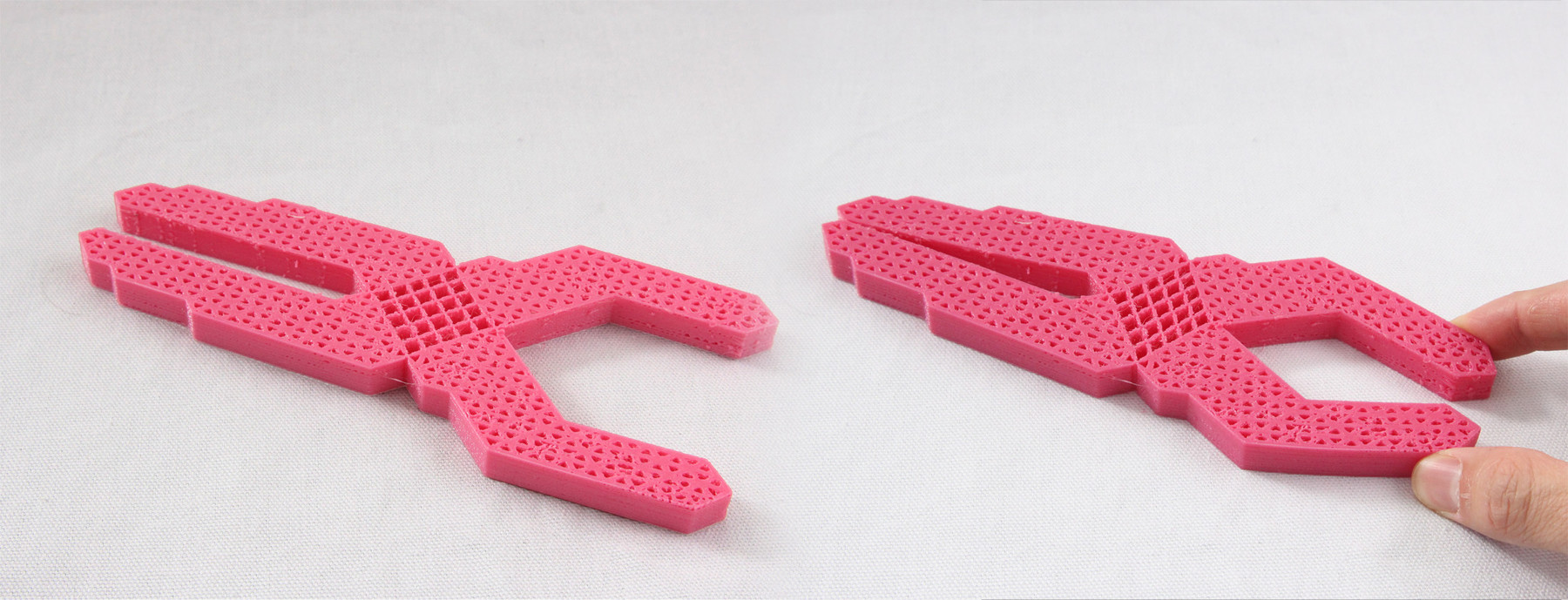
As the authors explain in the paper, the research explores the idea of considering metamaterials as machines rather than just materials by creating objects that allow for controlled directional movement. This allows users to create objects that perform mechanical functions.
FDM and stereolithography
I had access to two different 3D printers this week: First the Sharebot's Kiwi which is a low-end FDM printer with a printing volume of 100x100x140mm and without heated bed so it is mostly suitable for PLA and similar materials that adhere well to the base without the need of additional heat. Second, Formlabs Form2, a desktop stereolithography printer which is very simple to use and delivers an almost hands free experience with almost no learning curve to produce high quality results.
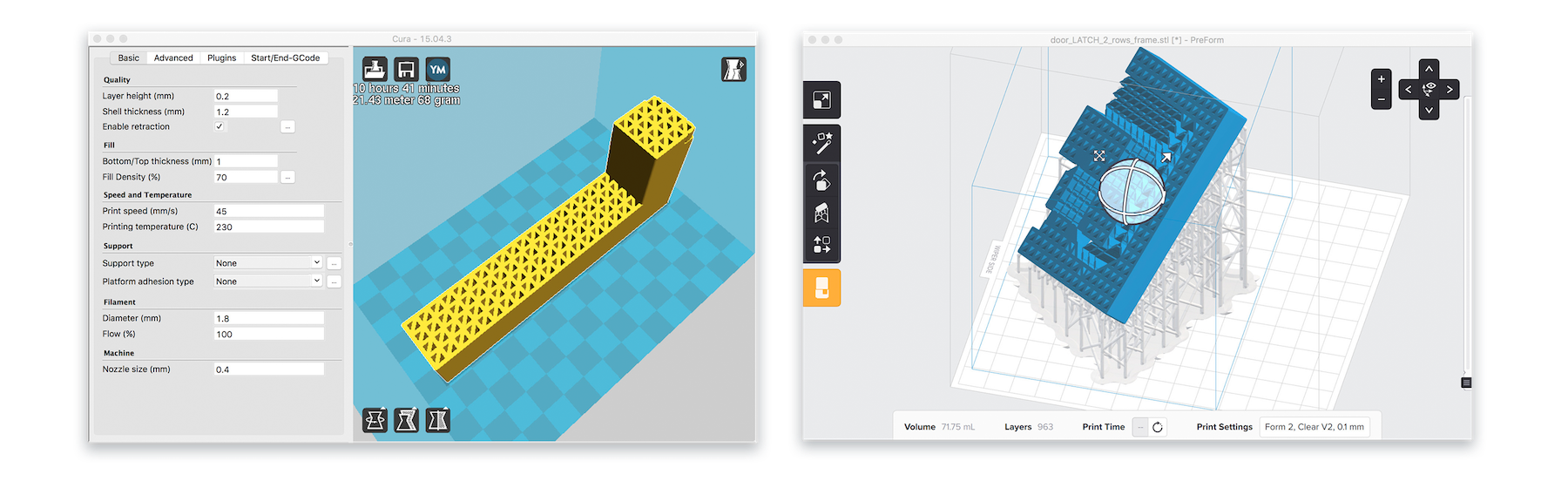
Softwarewise, for the Kiwi I used Ultimaker's Cura with Sharebot's custom .ini profiles, for the Form2 I used Formlabs own Preform software. In the last couple of years slicer and preparation software has improve dramatically and somewhat reflects the recent popularity and widespread use of desktop 3D printing.
Printing a metamaterial latch mechanism
One of the published metamaterial mechanism examples was a door latch which I got very interested about as a variation of this design could replace the milled or cast metal hardware of my window. The paper promised a great strength and durability but in order to be sure I would need it to test it myself. So I planned to print a version on each 3D printing technology and test both.
Unfortunately, in the case of the Form2 I didn't have any flexible resin. I have order some and I will be doing test in the following weeks. Meanwhile I printed a test on clear resin which is the only one that I have access to this week.
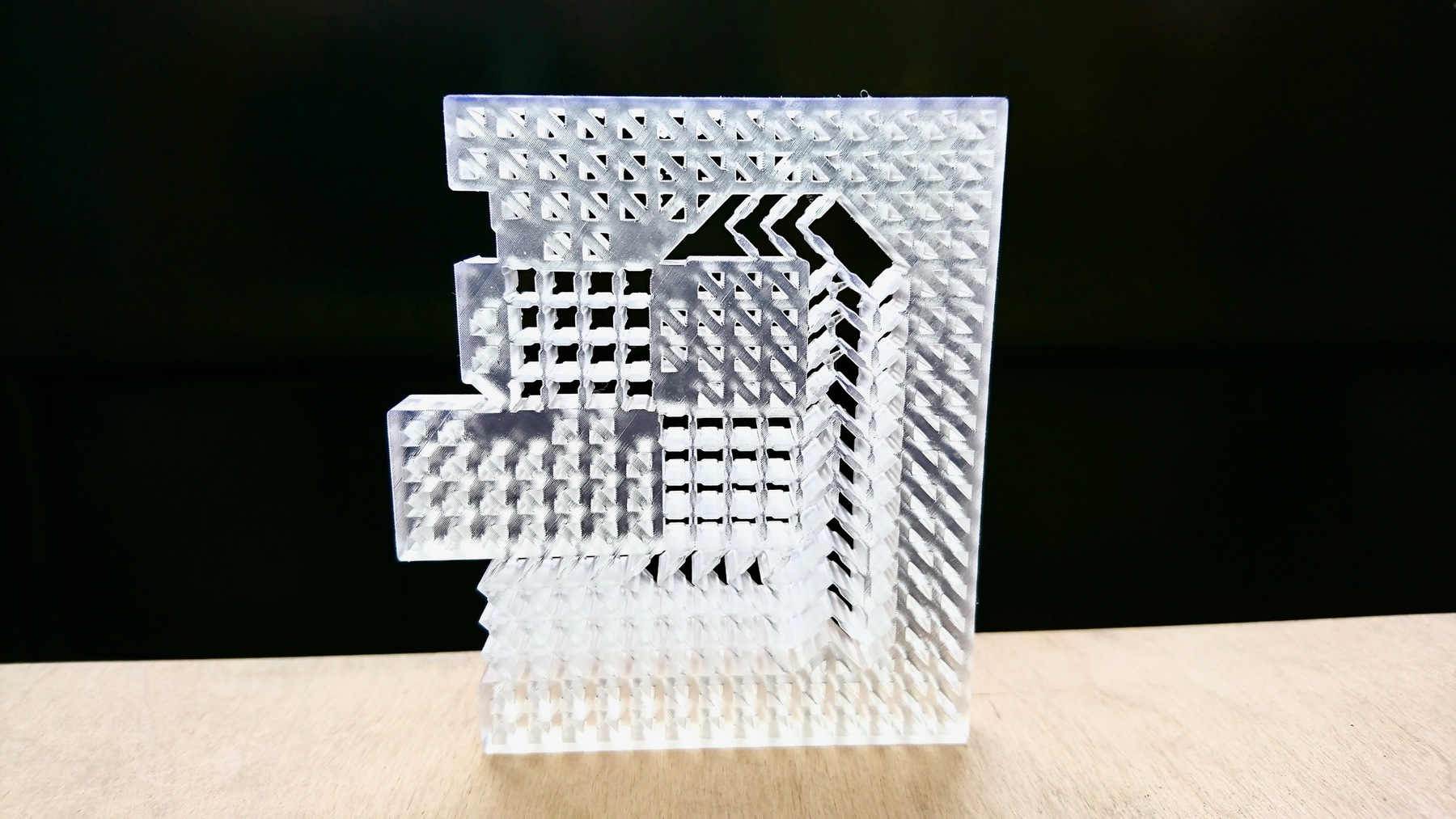
It is understandable the enormous hype that the Form2 has generated recently as they have managed to deliver a simple, reliable and affordable product. I am really looking forward to print with the flexible resin.
On the other hand FDM printing –despite machines have become very reliable– still requires plenty of fine tuning in order to get good prints. I used Ninjaflex which is one of the best know flexible filaments in the market, following carefully their printing guidelines:
| Extruder Temperature | 225°C – 235°C |
|---|---|
| Platform Temperature | Room temperature – 40°C Glue and/ or blue painters tape is suggested if not using a heated bed |
| Print Speed | Top and bottom layers: 10-20 mm/ sec (600-1200 mm/ min) Infill speeds: 15-35 mm/ sec (900-2100 mm/ min) Layer 2+ use cooling fan if available. |
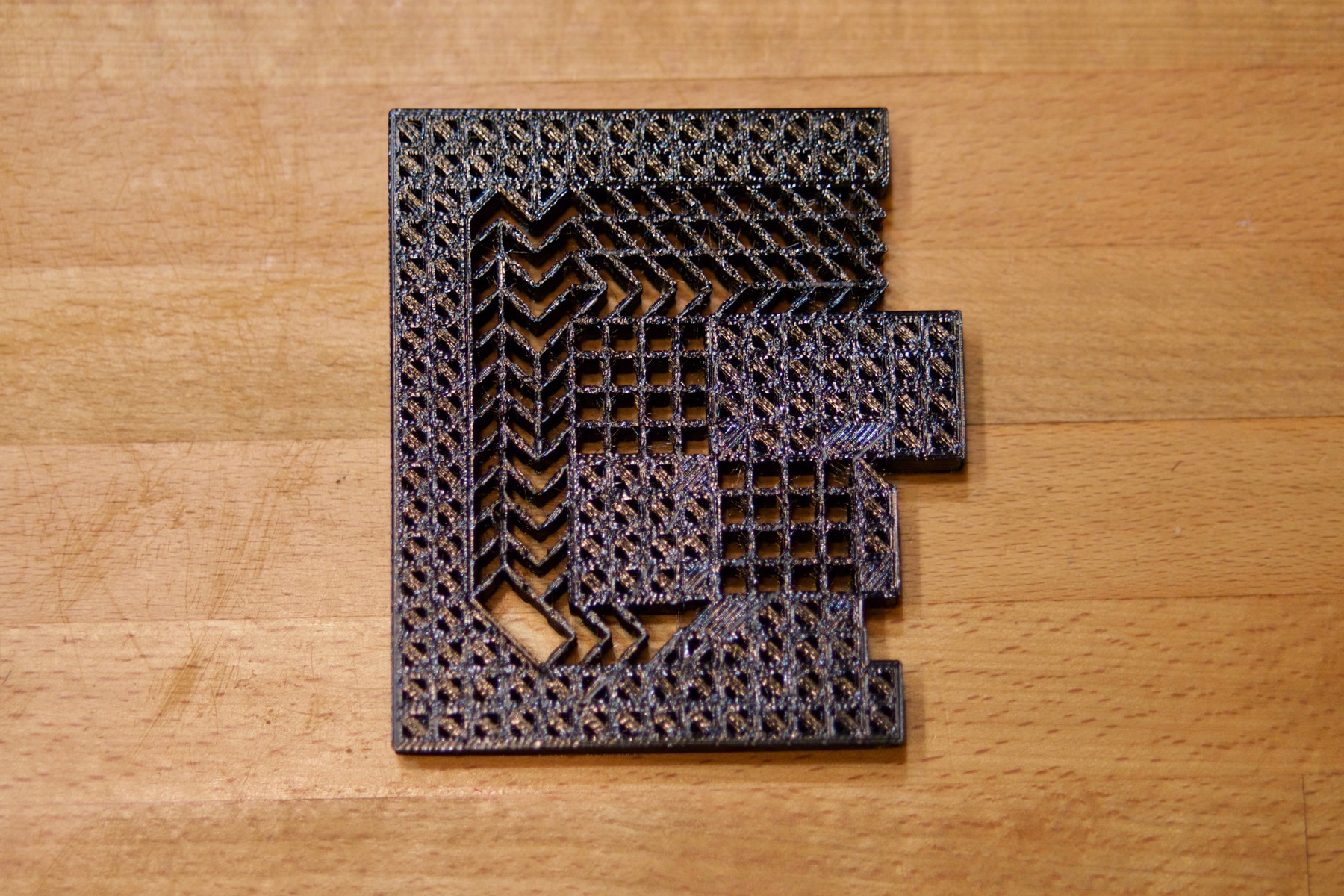
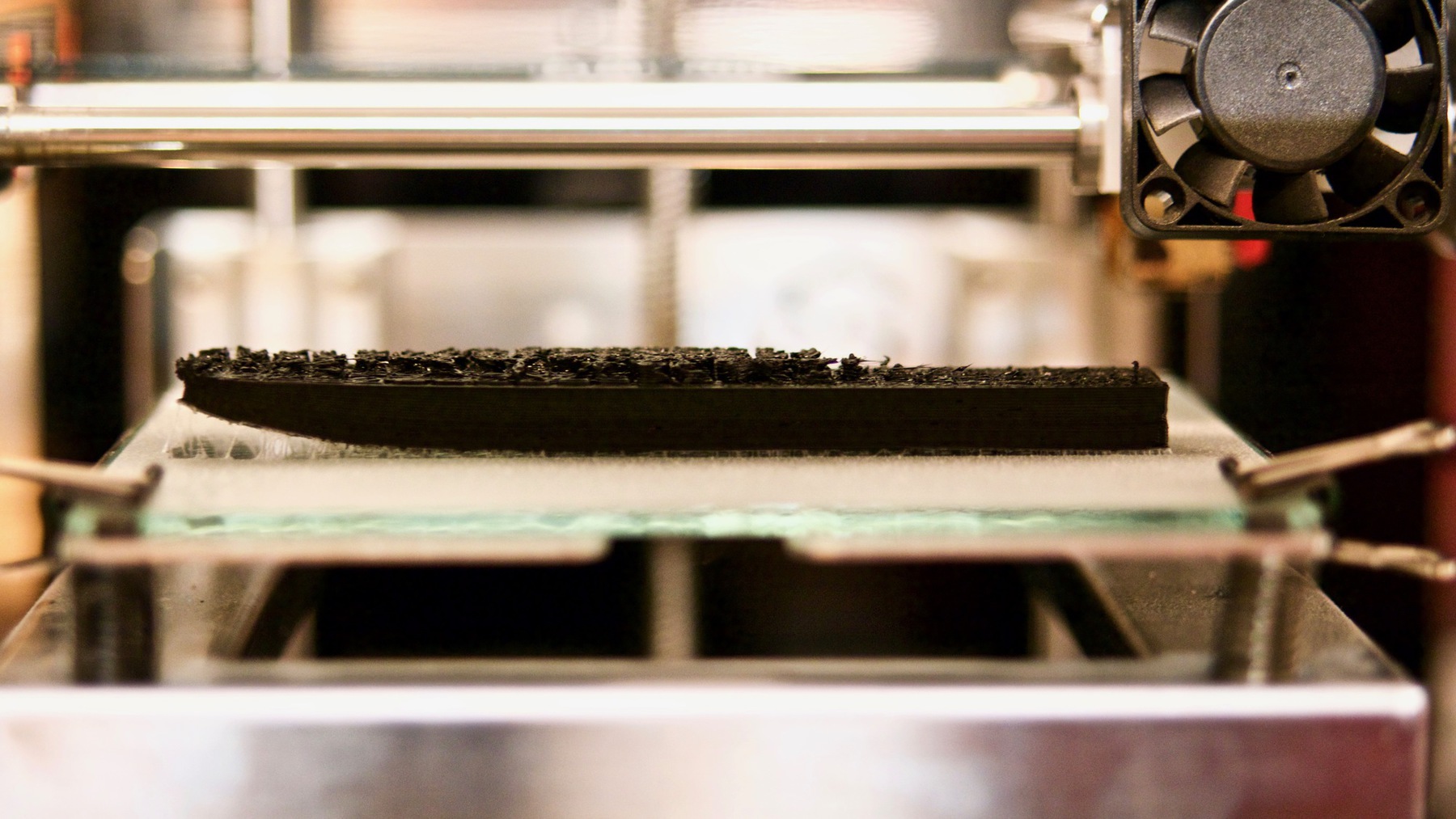
Results were not that good as to date I havent able to prevent yet a noticeable warping on the bottom side of the pieces. I believe that this is caused by the lack of a heated bed on the Wiki's design, I tried to minimize this by spraying adhesive to the base which it worked ok on the larger surface prints but did not help much on prints with smaller surface contact.