Exercise 18 - Invention, IP & Income
Assignment
Our assignment for this week is to develop a plan for the dissemination of our final project. The assumption is that our project will be successful. As part of our write-up, we have to consider our plan for dissemination of our project, whether we should file protection of the intellectual property (IP) that we created, using the various means IP protection.
A secondary assignment is to prepare both a summary slide and a short (< 1 min) video clip of our final project.
Protection of Intellectual Property
Intellectual property (IP) is one of the key assets of many organizations. There are various means available for IP protection:
- Patent
- Trademark
- Service Mark
- Copyright
The US Patent and Trademark Office (USPTO) describes these various forms of IP protection as follows:
- Patent: a limited duration property right relating to an invention, granted by the USPTO in exchange for public disclosure of the invention. The duration of the patent protection depends on the type of patent granted: 14 years for design patents and 20 years for utility and plant patents.
- Trademark: this is a word, phrase, symbol, and/or design that identifies and distinguishes the source of the goods of one party from those of others. A service mark is a word, phrase, symbol and/or design that identifies and distinguishes the source of a service rather than goods. The word "trademark" is often used to refer to both trademarks and service marks. Trademarks have no expiry.
- Copyright: protects works of authorship that have been tangibly expressed in a physical form, e.g. books, movies, songs and works of art. For works created by an individual, copyright protection lasts for the life of the author, plus 70 years. For works created anonymously, protection lasts 95 years from the date of publication or 120 years from the date of creation, whichever is shorter.
Patents and trademarks are filed at the US Patent and Trademarks Office, whereas copyrights are filed with the US Copyright Office for the US. IP protection has only national jurisdiction and gives the owner to pursue legal action against anyone who infringes on the IP.
There is a very concise description of the differences between the different types of IP protection at the USPTO. The link also contains a nice video describing the differences.
The legalzoom.com website has a simple chart showing the differences between these 3 forms of IP protection. I've reproduced the chart here. If legalzoom, in order to protect their copyright, requires me to remove the reproduced chart, then please drop me an email :)

Types of Licenses
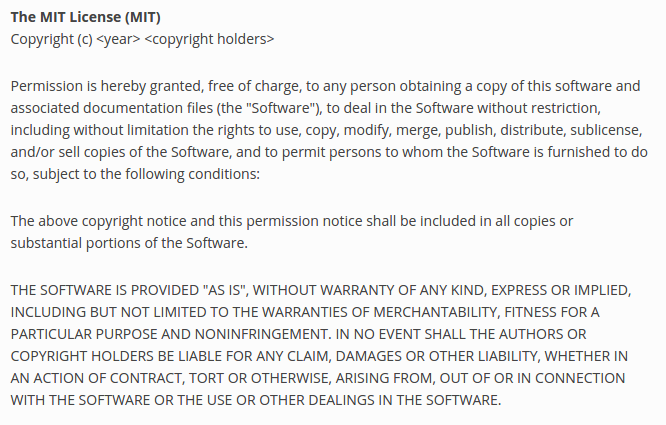
One of the goals of my final project is to develop a low cost 3-axis CNC machine which can be duplicated and fabricated by anyone, anywhere. As such, I'm would go with a loose form of copyright protection for it. The Internet also has many 3-axis CNC designs. I have learned a lot from looking at designs published by other Internet users. The software that I am using for my project is the free, open-source g-code intepreter, Grbl. Grbl v0.8 and below was released under the permissive MIT-license.
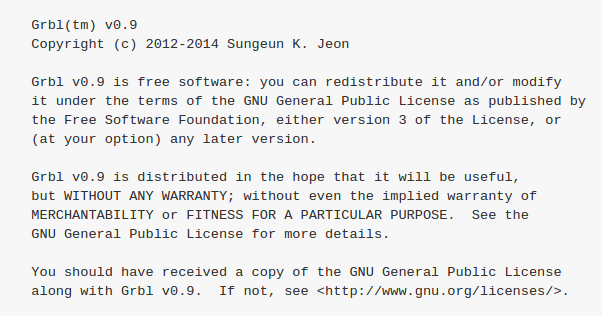
GPLv3 v0.9 is certified open-source software, released under GPLv3. It is not public domain or free software and the copyright remains with the authors of the software. GPLv3 allows users to redistribute and/or modify the software under the terms of the GPL license, as published by the Free Software Foundation.
Since my final project was developed as part of the Fab Academy course, I would go with the Fablab license. This license states:
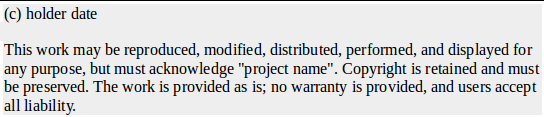
The terms of the license is very simple - users are allowed to modify or reproduce my project, but they will need to acknowledge the origins of the project. I would also retain copyright for the project.
Project Dissemination
The current project that I am working on for my final project is just the beginning of my foray into the exciting world of machine building. I hope to be able to continue down this path and build many more useful and exciting machines. Since this is my first build, there is really nothing revolutionary or groundbreaking in my design. As such, I would publish it under the Fablab license as described above.
To further disseminate the benefits of fablabs and digital fabrication, I hope to show that setting up a fablab doesn't have to be expensive. These amazing machines could be build within a fablab and rolled out to other new fablabs. In order to do this, I hope to disseminate information on the 3-axis CNC that I built and DIY MTMs in general and what they can do on as many platforms as possible. Some of these platforms are discussed in the following paragraphs.
My final project details and implementation would of course be published on my personal website in the Fab Academy repository. The repository is freely available to anyone with Internet access. The Fab Academy archives is well known amongst the global fablab community, but probably not as well known amongst the general Internet community, so I would also publish my project on other platforms.
One of the most popular sites amongst the DIY and maker community is the Instructables website. As such, I plan to write-up my project as an Instructable and publish it on their site. Together with publishing the build plans on Instructables, I would also upload the entire project contents on GitHub.
My initial impression of Thingiverse was that it was a site with parts for 3D printing. I have since revised my impression, as I found many other types of projects on Thingiverse, including CNC, laser engraver and 3D printer builds. Since my project also contains 3D printed parts, I would also take this opportunity to publish my entire project files on Thingiverse, where it would be available to a wider range of people.
The Openbuilds site is a website dedicated to machine building. There are sections on routers, 3D printer, laser cutter and various types of CNC machines. This would be a good platform for me to publish my final project. The reservation that I have is that many of the machines presented on this site are of quite high standard, so I would probable only publish versions 2 or 3 of my CNC build, in keeping with the standards of machines published on this site.
Fablab SP and Singapore Polytechnic as a whole sees many visitors to our campus during the year. We also participate in a number of events and exhibitions, such as Makerfaire and InnovFest unBound. These would also be good platforms for me to disseminate information about my low-cost DIY CNC and the Machine Building capabilities of our Fablab.
Income
At this point in time, I am not looking at generating any income from my final project. I intend to build more machines, as part of our plans to build up the machine bulding capabilities of Fablab SP. I hope to be able to design and build many more types of digital fabrication machines and even multi-function and portable machines.
If we get to a stage where the machines we build have unique design features or outstanding cost/performance, then I might think of going into commercial production. To do this, there are a number of avenues available, such as Kickstarter and Indiegogo. Singapore also has a number of VC and angel investors, who have invested in a number of startups over the years. Being in an IHL, we have had dealings with some of these people and I might tap on them as a source of startup funding. SP and the Singapore government also have a number of funding schemes available and I would look at them as well.